Table of Contents
Get Ready to Monetize Your Blog!
In order to make money from a blog, you first need something to sell. Affiliate Marketing is a great way to earn a passive income without having to have a product of your own.
This post may contain affiliate links.
Instead of waiting for 3rd party ads to load, you get a list of hand-picked ads that I manually link to and make a small commission if you purchase from that link at no extra cost to you. I also link to other places I don’t make a dime if you buy. Don’t buy anything you don’t want.
Read more about it here: Affiliate Disclosure

Kimi’s Affiliate Marketing Course
Kimi Kinsey’s amazing course on how to earn money and be successful with affiliate marketing regardless of your niche. Learn how to amplify your blog’s earning potential. Link above is my affiliate link, and I make a commission if you decide to purchase her course 🙂
AFFILIATE MARKETING
Affiliate marketing is one way of many to generate a revenue stream for your blog. In essence, you choose specific products or brands you want to endorse, apply to be an affiliate, and once approved, you place special links to the purchase of those products. Any time someone buys from your link, you get a commission.
Percentages of commission differs between places. A higher percentage doesn’t always mean a higher pay out. You want to think about several things in regards to “maximizing revenues” in addition to the percentage…
- The price of the product
- Recurrence of payment + How long the company will pay you for recurring charges
Overall ideas to consider when trying to find places to affiliate with.
- What is your site about?
- What might your target market buy?
- What do they NEED to function?
- What are they already buying anyway?
When trying to decide if you want to affiliate with a specific product, you can ask yourself these questions…
- Does the product make sense for your niche?
- Is this a product your audience would love to have?
- How many blog posts do you think you can write about their product?
- Can you do a comparison of that product with a major competitor that people are really iffy about buying?
- Is the product something people often research before buying?
- What keywords and questions are people searching for in regards to that product?
The reason I ask these questions is for affiliate marketing to work out for you, you’re probably going to want to do more than just plop a link in random places. There are several ways to approach your strategy, but you want to have some kind of strategy for promoting the said product.
For instance, with Blogging Learn, I have more to say about my experience with different hosting providers than I do my experience using different themes, so while I do have a theme person I affiliate with, I plan on putting more emphasis on hosting.
A person who blogs about DIY Home Decor might want to affiliate with Home Depot, but then they will be almost forced to use Home Depot purchased items in their DIY Decor, whether it’s the wood or the glue. A food blogger might do well to affiliate with a butter company, but then you’re going to want to be exclusive to that ingredient (your brand over other brands, butter over margarine).
Don’t worry about having all your ducks in a row and trying to figure out your end game from the very beginning. Often, with many bloggers, they start out with just one product (or a small handful) to promote, and then build from there.
But the first product (or handful of products) you promote should be something you can work with.
What is the ONE thing you feel like you could both endorse as an expert and sell as an influencer?
For Michael Jordan, it was Nike shoes.
Try to find your Nike Shoes.
PRIMARY AFFILIATE PROGRAMS
These places do affiliate marketing, and when you sign up with one, then you can apply to the companies they have on their list (merchants who pay them to find affiliate sales people for them). From your dashboard, you can obtain links, banners, etc. They offer all types of affiliate marketing for just about every major category or niche you could possibly write about.
Awin: Popular merchants include Etsy, Fiverr, and Swagbucks.
Then strangely different, but SOVRN // Commerce does something where it monetizes and optimizes monetization of existing product links. I’m not sure how it works. From my understanding, you paste a snippet of code, and all your links to products are affiliate links that will pay you for every purchase, and each link will forward to the best bang for your buck retailer.
AMAZON ASSOCIATES
Many bloggers love the amazon affiliate site because it allows them to earn a percentage on any product sold through Amazon, and Amazon has something for everything. When in doubt, sell books in your niche.
Keep in mind that Amazon has a lot of rules. A LOT OF RULES. And I have found Kimi Kinsey to be the best at helping people navigate through those rules. (I used an affiliate link to that blog post).
Amazon has always been considered the Creme de la Creme of affiliate marketing simply because they have a product (several products) for anything, and it’s too easy to order them online + they are a trusted brand that people don’t feel like they are taking a huge risk to give them their credit card info.
VARIOUS WEBSITES
What I did was write a list of things I bought for my niche because those are things that I wanted to buy, needed to buy, and can easily recommend.
Then I went to all their websites and looked at the footer and throughout for AFFILIATE or PARTNER WITH US links.
Some of them are in the affiliate companies listed above (like Share A Sale), but others operated out of another company or as themselves. But I aimed for stuff I was planning to recommend anyway, like from woman to woman la mano to mano.
I have also found myself recommending someone frequently, so I checked out how to be an affiliate and added them. You don’t have to know everyone you plan to affiliate with at the beginning. You can always apply and add any time.
RECOMMENDED TOOL > Trello
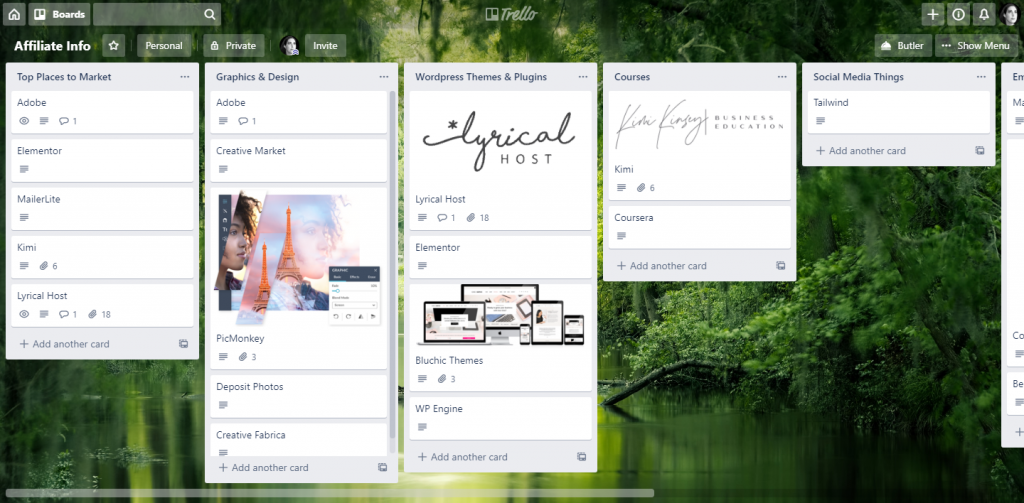
Most people who do affiliate marketing on their blog(s) end up with a huge list of places they affiliate with, often requiring logging into different websites, often with its own set of rules, often with its own set of links, and with their own images and graphics.
Just for sake of remembering where to log in, your username and password, I highly recommend coming up with a system to keep track of these things.
I have found Trello to be the easiest way to organize this info, especially if you’re already on it for other organization reasons like many bloggers highly recommend (and even offer free courses on).
I am using the FREE version.
What I did was create a Trello board for Affiliate Info. I made lists by category. On the cards, I put images, log in info, links I plan on using if I can copy and paste them easily, and some basic info on the product(s).
I also created a list of things I want to focus on, copying cards from the category lists. These are either things I love LOVE, or are bigger paying ticket items, or are things I feel are completely necessary to the purpose of my blog.
You can probably just as easily use a Spreadsheet, create a draft blog post that you never publish, or use a regular notebook, but the idea is to keep track of all your information in one place because the first step is signing up to be an affiliate, but the real work is applying links within your posts and basing some content on these links and sales. You’ll most likely be referencing your links and info on a regular basis.
Similar to Trello is Taskade, and I like it too because you can set it up as a Chrome Extension and it will show up in lieu of Google Search if you’d like every time you open a new tab.
Good Reads from the Web