


Warning, this blog’s purpose is to take a “professional” sounding advice and turn it into easy to understand stuff, and be entertaining enough to keep you awake through it. Consider this that boring seminar you HAVE to attend, but I’m the speaker wearing a light up tie.
If you blog, there’s a chance you have some extra income you might need to claim for tax purposes. Let’s talk about that. I put the important crap in the color of turd soaked dehydrated urine (it’s a burnt orange). I also put in funny pictures for an eye break.
Table of Contents
How do you know if you HAVE to file it or claim it?
Did you make $400 before expenses (GROSS)? If the answer is yes, file and claim. If not, it’s up to you.
The reason is self employment tax… The IRS wants you to pay for the social security and medicare employers usually take out of your check and match, that as a private contractor, you didn’t have to pay. The IRS has a bigger amount for “Did you make this much last year” to tell you if you need to file, but that’s for W-2 income. 1099-MISC income and other income earned without tax papers are usually claimed in the form of a small business requiring you to pay self employment tax. The IRS wants their money.
My personal advice is ALWAYS FILE regardless of what the IRS says. They are shady motherfuckers there at the IRS, and I don’t trust their own manuals. They know their own loopholes to fuck us over better than we ever will to avoid being fucked. When the IRS thinks you owe them money, let’s just say, the odds are more in your favor to negotiate with a Mexican Drug Cartel over unpaid debts. If you don’t need to file, then file to prove to them you didn’t need to file.
Plus, if you set your blogging up as a business, you want years and years of records of what you made, even if you didn’t make that much. Businesses popping in and out of existence between years might trigger an audit faster than businesses who are steadily earning a little bit of income every year.

How to claim the Income?
You have two choices for freelance writing income and other blog income: Business or Hobby.
Claim it as Business Income
You can set your blog up as a business and claim your income and expenses on a Schedule C like you would any small business. Most 1099 MISC goes here. In fact, if you receive a 1099 MISC for more than $400, you probably want to go this route because the IRS wants to tax you for that.
Claim it as a Hobby
There is a place in the dark corners of the 1040 where you can claim “Other Income.” Hobby income goes here. It seems easier because all you do is put in the amount you received as income in that box. But it’s more complicated, because in order to claim expenses, you must do so on a Schedule A, and you can’t claim anymore in expense than you made. In other words, you may not get to claim expenses if you take a standard deduction (it would be implied in that standard deduction). If you itemize, you only get to claim expenses up to the amount you received. You can’t have a negative income for hobby income like you can a small business.
BUT, you don’t have to pay self employment taxes for hobby income. SE tax is based on how much you claim. If you are claiming a small amount with no expenses, like $400 from various companies, or even $50 you made on Etsy, this might be the way to go.

Which way to go?
The IRS usually defines hobby as income you make doing something you want to do, that you would do even if there wasn’t an income, where the sole purpose of doing it is because you want to do it. A business is something you do to make money, where the sole purpose of doing it is to make money. Most blog income qualifies as both. It is something you do for fun, but you turned your fun into a profit-seeking venture.
While many tax preparers and accountants consider the short-term benefits of classifying income one way or the other, you have to think about the long term. If you see your blog as a business in 10 years, go the business income route. If you see your blog as a hobby or nonexistent in 10 years, then base it on where it best serves you for that year.
Another consideration is EIC. In order to qualify to receive the Earned Income Credit, one has to have earned income. Some tax preparers say for joint returns, only one spouse has to have earned income to qualify; however, the IRS PUB 17 flat out says BOTH spouses must have earned some income to qualify. I always wanted to be safe not sorry back in the days our income qualified us for the EIC, and I claimed my blogging money as a business so that it would be earned income.
While we are probably talking a few dollars between Sch C and Hobby income, the easiest way to find out which is best for your return that year is to do it one way, see the amount, and then do your taxes again the other way to see the other amount. If you have other income from W-2’s, spouse income, and so forth, most likely going either direction won’t change your tax situation any more than what you pay an HRBlock to prepare them for you.
Multiple Business Projects
I know many bloggers generally are all over the internet. Maybe you have multiple blogs, or multiple forms of blog income. In my case, my income one year had money from an SEO organization, graphic design payments, t-shirt sales from Cafepress and Zazzle, and font sales on My Fonts. I’m all over the place, and I wasn’t about to do 5 schedule C’s. I lumped it all under one business under the name of Gabbysol Neterprise (named after my kids Gabby and Solma). Just add all the income together under receipts. Multiple 1099’s? You can do them separate if you wanted to, but I wanted to point out, you don’t have to. Many companies do business under a different name and have many small companies consolidated under a big name.
Schedule C Expenses

The regular way to do taxes is just spit out the information. Honestly say how much you made, and honestly claim expenses. BUT, with blog income and expenses being so easily loss worthy, you kind of have to ask yourself at some point if it’s in your best interest to claim a loss.
When I file my business, I always claim a profit. If my gross income is smaller than my expenses, I just don’t claim my expenses. I do this because like I said earlier, years of a small business steadily producing a little bit of profit are less apt to get audited. If you claim a loss more than 3 years in a row, the IRS is going to start asking why are you in a profit seeking venture if you aren’t making any money in it? I believe their computers automatically look for businesses that always claim a loss. It’s about as big of a mistake to make as having two people claim the same social security number. It’s not a matter of odds like some discrepancies where it depends on if the right person sees it at the right time.
Most tax professionals will tell you want to have a loss to maximize your refund that year, and they try to make the loss as big as possible claiming every expense you can possibly claim. They would be wrong to do so all the time. In some instances, you benefit by claiming more beyond avoiding audits. If you qualify for the EIC, the extra money might make a bigger return on a refundable credit despite paying income taxes on the amount than if you didn’t claim that money at all or less than it.
Boring shit to explain the EIC thing…
When you file taxes, you have income, subtract adjustments to income, and you get an AGI (Adjusted gross income). You then deduct your standard or itemized deductions and your exemptions, and then you pay taxes on that amount. Changing that amount a few hundred dollars doesn’t really change your tax liability by much because it’s a small percentage of a big number. After you find your tax liability, you then deduct two series of credits. One is the non-refundable credits like the Child Tax Credit. These only reduce your tax liability down to zero. They won’t go any further than that. Then you can deduct Refundable credits, which are credits that can turn your tax liability into free money from the government. This can bring that zero into the negatives. The EIC is a refundable credit, and it is based on a bunch of variables.
The EIC chart has a list of how much you have to make, how many kids you got, and then it tells you based on that how much you can claim as a credit. This is dollar for dollar. There is no percentage of a huge number. The chart is a curve when it comes to income. If you make a little bit of money, you can get a little bit of money. The more you make, the more you can get. Then it peaks at 18,000 to 22,000 and flips to where the more you make, the less you get until you make too much to qualify for the credit at all.
If your other earned income is very little, the more profit you claim on blogging income could increase how much you get with the EIC. If you (or you and your spouse on Married Filing Jointly) make less than 20,000 a year, you would probably bank to claim more income in your business than less without going over the peak amount for your tax situation (single vs joint, and how many kids you got).
If you decide it’s in your best interest to claim expenses, here are some types of things you can deduct:
1. Tickets to conferences and seminars regarding blogging and writing.
2. Travel, some food and lodging, mileage or plane tickets, for conferences and seminars
3. Did you travel to promote a book you are in? That counts too.
4. Subscription fees you have for business purposes (i.e. if you subscribe to the Wall Street Journal just so you can submit your writing to them… If you subscribe to freelancer.com or a site like that where you pay to find jobs… If you subscribe to a site that gives tutorials… )
5. Website expenses (web hosting, domain registration, WordPress themes and plug ins)
6. Contract labor (did you hire someone to do your graphic design? Or design your website?)
7. Advertising
8. Promotions… Did you purchase 5 copies of a book you are in for promotional reasons?
9. Postage for submissions (for those who don’t email them)
10. Anything related to your craft that you have a record of paying.
What you probably don’t want to claim in case you get audited?
1. Vodka, coffee, or any drink you require to write with.
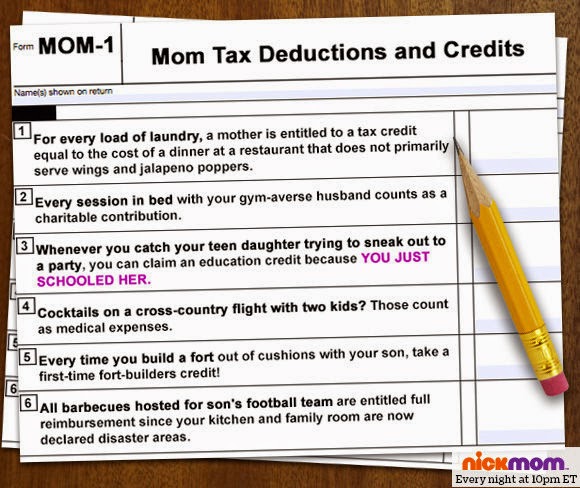
2. Child care deductions so that you can get something done can be claimed elsewhere on the 1040.
3. Money spent bribing a spouse to take the kids somewhere does not qualify as child care expenses
 |
| Check it out on Nick Mom |
Home Offices
That’s a tricky expense, but you can claim the portion of your home you use for business, especially if you store inventory, and the portion of the computer and internet you use for business; however, if you use these things for personal reasons at all, I suggest not worrying about it. I’m not going to do what other sites do, and sell you a possibility that isn’t really worth pursuing just to get you to read my blog… BUT if you bought a computer and use internet strictly for blogging and all things related to your blog, and nothing more, then you could probably claim those things. This is a gray area the IRS has yet to define because just about everything we do online is related to our blog. As a writer, any social media presence is work. Any google search is work.
For me, everything I do on this computer is related to writing and design; however, I don’t claim it because the year I purchased the computer was before I had a business, and the internet is shared by the family and some neighbors. The place this computer sits in my home is so small that I would lose money if I put a value on my time to claim it.
FILING A 1099
Did you pay someone more than $600 to do some work for you?
You may need to file a 1099 if so. Check out When Do You Need to File Form 1099-MISC? for more info.
Cash vs Accrual Accounting
 |
| I was in bookkeeping too and found this hilarious. I love reconciliation. |
Cash based accounting means you claim the money the moment you get it. That means the moment you get paid, you claim it.
Keeping Records

The IRS has a nasty habit of waiting like 3 years before they decide to audit you. It’s because it usually takes them quite some time to discover you. And if that happens, you are most likely not going to remember where you got your information. So when you file your taxes, it’s important to keep information on file somewhere.
Tax Preparation vs Accountant vs DIY
 |
| Click to see more pictures like this |
I managed tax offices for a couple years, and THEN I took Federal Income Tax Accounting at a university. I can vouch that the Jackson Hewitt’s have a better grasp of tax laws and IRS requirements than someone who completed the college coursework. That textbook did everything wrong. It actually went against what the IRS says. I’m not sure why, but as a result, I don’t trust accountants as much as these little tax preparation offices. The difference is the accountant gets his training from college. Tax preparation offices usually have a training of their own based on material directly from the IRS, and their training provides more realistic real-world scenarios based on the volume of taxes they prepare every year. And the people doing your taxes there only do that, so they know it well. Accountants do so many other things, way more complicated things, that they aren’t always so up-to-date with specifics regarding personal tax preparation.
But as a former tax office manager who trained the 12 week course for Jackson Hewitt, who also was trained with college coursework and VITA training, who also volunteered to provide VITA training, I do my own taxes. I wouldn’t have it any other way.
I hope you find this information helpful. Have a Happy Tax Season and may the audits be ever in your favor.
